
A Rust and WebAssembly-native runtime for building, running and connecting applications across heterogeneous devices, from Linux gateways to microcontrollers.
Myrmic gives you the runtime primitives to build and run distributed applications across real-world devices. You write your application logic as portable WebAssembly modules, while Myrmic handles execution, messaging, state, and placement across the system.
Run WebAssembly workloads through a common runtime.
Communicate across devices without central brokers.
Keep application state close to where your workloads run.
Coordinate workloads across participating devices.
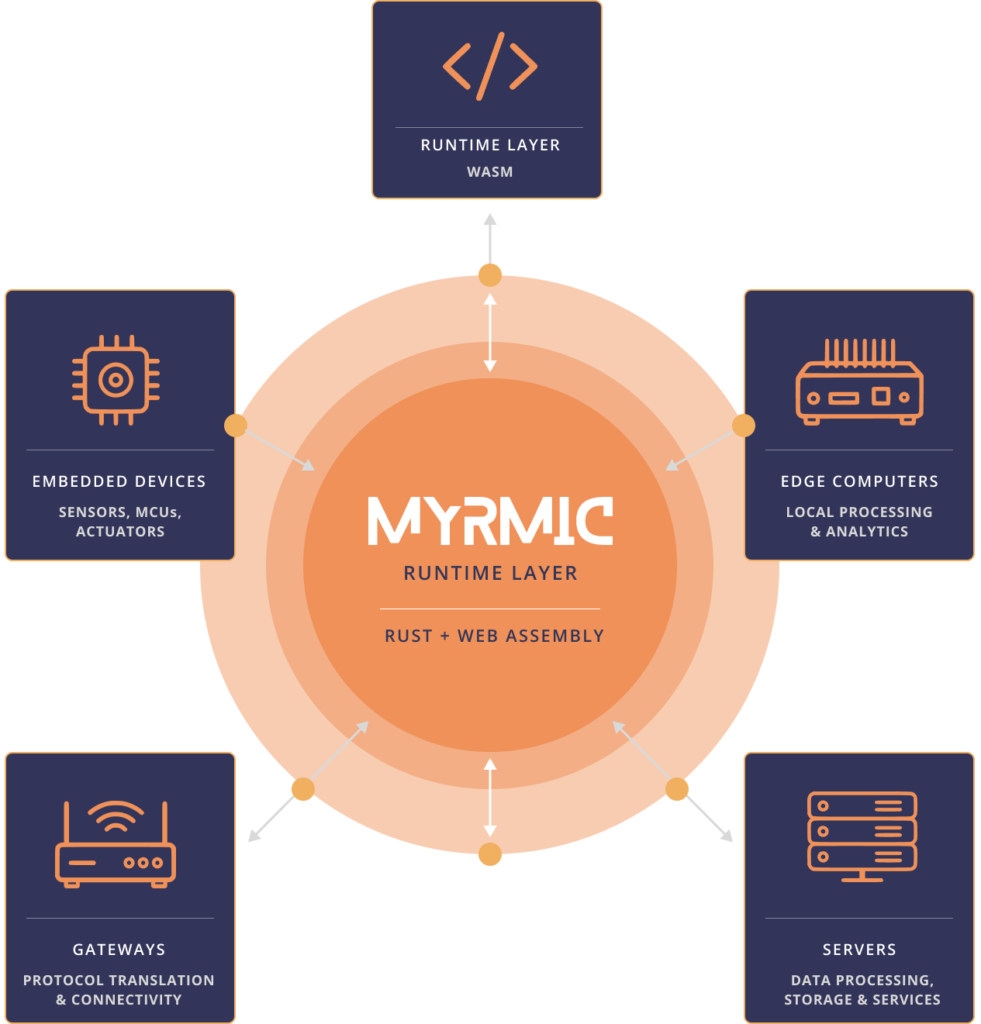
Myrmic provides a Rust and WebAssembly-native runtime across embedded devices, gateways, edge computers, and servers, giving applications a shared foundation to run and coordinate across different hardware.
Clone Myrmic from GitHub and follow the setup instructions.
Write your application logic in Rust and compile it in WebAssembly
Start locally on a Linux system and inspect how your workload executes.
Move from a single host toward a distributed setup using supported targets.
Run application logic across devices that need to communicate and coordinate locally.
Explore applications spanning more capable Linux machines and constrained microcontrollers.
Build systems that can coordinate locally instead of depending on a cloud round trip for every interaction.
Explore Myrmic APIs, interfaces, types, and implementation details.
Learn Myrmic concepts, architecture, setup, and development workflows.
Browse the source, track issues, explore releases, and contribute.
Whether you want to explore our technology, discuss a potential partnership, or simply learn more about what we’re building, we’d like to hear from you.